
What will I learn?
This module identifies key strategies to identifying and recruiting potential volunteers from your membership and supporter base.
How long will it take?
This module will take approximately 15 minutes to complete.
Who should complete this module?
This module is designed for club leaders responsible for recruiting and coordinating club volunteers.
Section 1
Review Volunteer Roles Audit (see module 1)
Categorise Vacant Roles
As per the roles audit discussed in Module 1, roles shouldbe separated into two categories:
Seasonal / ongoing roles

Seasonal or ongoing roles are a season long commitment, examples include: committee member, coach, team manager, canteen manager, gameday administrator

Casual / roster-based roles
Casual or roster-based roles are roles that are required to be filled on a weekly/monthly basis but do not necessarily need to be completed by the same person every time, examples include: canteen shift volunteer, timekeeper, umpire, admission/gate attendant
Section 2
Section 3
Additionally, utilise a digital survey platformto streamline the distribution of the survey to the membership base and clubsupporters:
Section 4
The survey should include the following questions as a minimum
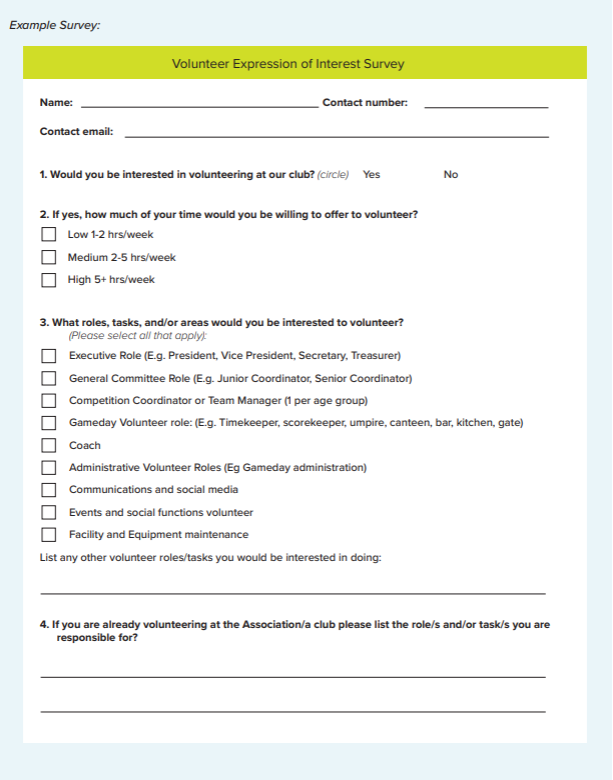
Section 5
Organise the responses to the survey into a digitalspreadsheet, see below for an example:

Section 6
A primary challenge for recruiting volunteers is members notknowing what they are putting their hand up to volunteer for.
For seasonal roles where there may be multiple aspects tothe role. In these instances, preparing volunteer role descriptions can helpdemystify the roles and responsibilities of certain volunteer roles.
For templates of volunteer role descriptions visit:
https://www.volunteeringvictoria.org.au/sport-volunteering/resources/
Section 7
Section 8
As with seasonal/ongoing roles it is important for casual/roster-based roles that incoming volunteers are aware of the requirements of the role. In this instance role descriptions may be too overwhelming for a casual volunteer, however a simple guide, checklist, or instructional manual may help.
Section 9
There are different types of incentives that clubs can offer, to entice people to take on volunteer roles. Any relevant incentives should be promoted and/or articulated when advertising to, speaking with, and recruiting potential volunteers.
Intrinsic Incentives
Practical Incentives
Monetised Incentives
Section 10
Volunteer Recognition – Celebrating a Culture of Volunteering
Recognising the contributions made by volunteers plays an important role in creating a culture of volunteerism.
Recognition involves regularly acknowledging small volunteer contributions as well as annually acknowledging large contributions.
Recognition needs to be embedded in club culture so that all volunteer efforts are regularly acknowledged.
When a club regularly recognises small volunteer contributions as well as major contributions, the idea of volunteering is presented as more achievable, normal, and less daunting.
Regularly recognising small contributions promotes a culture of volunteerism which in effect makes annual recognition of major volunteer contributions more significant.
Section 11
You have finished the Volunteer Onboarding and Recruiting Module. To continue your learning click on the next module button below.


